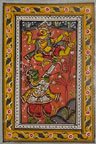
The Art of Kalamkari, South India

The Art of Kalamkari: South India

Painting, one of the most primitive expressions of visual art and communication has been a medium which has overtime enjoyed an explorative odyssey of being executed in varied techniques. The Indian artist manifested the aesthetic perception of culture and traditions by creating a harmony of visuals and emotions on extensive array of surfaces. From rocks to walls, bark of trees to metal surfaces, terracotta to glass, the Indian artist has delved into almost every possible kind of surface to articulate his imagination. Textiles are considered the most comprehensively used materials which has been illustrating the creative dexterity of the Indian artists.

The Indian subcontinent has been known for its rich, assorted textile traditions going back to almost 3000 years. Over centuries, diverse materials and ingenious techniques have been illustrating the vibrant social and traditional nuances of the people of this land. Topography, climatic conditions, cultural influences, trade contacts, religious beliefs and various other factors influenced the opulent textile heritage of the country and inspired the textile artists/artisans to explore the profusion of textile techniques.

Process of making Kalamkari
The Art of Kalamkari is an ancient and exquisite form of textile painting which has a heritage dating back to the ancient times. The term traces down its origin to the early period of alliance between the Persian and Indian trade merchants and identified any painted textile art form. Persian word Kalam or qalam allude to a pen or an instrument used for painting whereas the Urdu word Kari implies the craftsmanship involved and hence Kalamkari denotes the myriad manifestations of hand painted textiles.


Map of the Coromondal Coast, 
Image Credit-Columbia.edu

Historically, the art of Kalamkari most prevalently represented the textile arts practiced all over the Coromandal cost stretching from Machalipatnam at the north to southern parts of India, especially in areas like Kalahasti, Salem, Madura, Palakolu, Machalipatnam, Tanjore, Eleimbedu in Chengalpet, and in Cocanada districts.[1]

In present times, it epitomizes the technique of painting using natural dyes on textiles. Consequently, the wide range of hand painted and natural dyed textiles of India executed in various parts of the country are popularly recognized as the Art of Kalamkari.

 
In Southern India, Sri Kalahasti the pilgrimage city located on the banks of River Swarnamurki and renowned for the Shiva temple Sri Kalahasteewara has been considered one of the most prominent Kalamkari centers. The art form flourished under the royal as well as local patronage of the Hindu rulers in between the 13th to 16th centuries CE. The mythological textile paintings of this region served as narrative murals or temple hangings. Hindu epics like Ramayana, Mahabharata, Shiv Purana, Vishnu Purana and other legendary myths and tales were narrated and illustrated in elaborate ornate style in vibrant color palette of red, white, black, blue, yellow and green.
Epic of Ramayana painted in Kalamkari technique, Sri Kalahasti, Image Credit:Columbia.edu

Tree of Life on Palampore, 19th Century. 
Image Credit-National Gallery of Australia
In Northern Andhra Pradesh, the port town of Masulipatnam was a prominent trading site along the Coromondal Coast from where Kalamkari was traded to far off lands. Under the Golconda Ruler Qutab Shahi and his international trade alliance, Kalamkari textiles gained significance in Persian Safavid Empire for personal and domestic utilization. It was also the rulers of the Outb Shahi dynasty that gave the craft its name "kalamkari"--derived from qalamkor, an artisan who works with the pen.The Persian influence introduced an array of intricate forms and motifs representing trees, floral motifs, creepers and animal figures. With the advent of the Mughal Empire, new style of textile paintings emerged which represented personal portraits of the emperors along with panels depicting sagas of their rule and daily life. During this period Iran became a dominant patron of the art form and several centers were opened in the country to meet up with the Iranian demand for the textile art.

The art form adapted multitude patterns portraying religious beliefs, flora and fauna, ornamental motifs and the like under the influence of diverse patrons. Religious beliefs, traditional ethos, trade and cultural exchanges influenced the art of Kalamkari and extended its application from temple hangings to products of daily use. The Dutch and Europeans introduced the art form to assorted collection of products like home furnishings, canopies and garments.

Ceremonial cloth and sacred heirloom for Indonesian Market
Image Credit: National Gallery Australia
In history of Indian economics, Kalamkari textiles obtain imperative recognition as a medium of currency used in the spice trade. A wide range of ceremonial and ritual textiles as well as fabrics for apparels were created for Southeast Asia and Indonesia who were known for their exotic spices and oils and hence became significant patrons of the art form. This in return reflected back key aesthetical and cultural inspiration in the evolution of the art of Kalamkari. The European market declared it as part of the opulent Indian luxury goods and during the 18th to 19th century, Kalamkari textiles adorned the British Empire with exclusive hand painted home furnishings and dress materials.


Chintz Palampore, Image Credit:textilearts.com
 During the 19th Century, Chintz or Indian painted/printed cotton cloth became popular in Europe. Originally the term Chintz implied a pattern created on cotton fabric with a bamboo pen or kalam and dyed with mordants and resists. With the increase in demand block printing became the most favored medium. The shiny surface of the textile was created by finishing it with polishing it with a shell or other natural substance. 

Over centuries this textile tradition has undergone series of transformations. The strong spiritual base of the art form creating the most splendorous textile murals with time became the most flourishing popular culture. It then metamorphosed into a secular craft under the patronage of Muslim rulers and became to be known as a luxury good by the Europeans.The art of Kalamkari in Southern India has historically been one of the most significant textile traditions and still is practiced with equivalent fervor and dexterity.


Over the years the patrons and appreciators bespoke various names for the art form, the Portugese called it pintado, the Dutch used the name sitz, and the British preferred chintz. Along with the myriad range of names, the technique contributed in creating innumerable textile product range and till today is considered as one of the most celebrated textile art forms in India.


[1] Percy Brown in Arts and Crafts of India, 1903
Indian Religious Textile Paintings


In history of India amalgamation of arts and textiles has been formatting excellent examples of creativity and ingenuity over several centuries. The Indian artist explored different mediums to express his imagination and articulated them through myriad textile traditions. Spread across the country one gets to witness the diversity of textile art traditions which narrate the mélange of cultural beliefs, traditional ethos, myths and epics and eclectic depiction of life. Diverse techniques of painting and printing, weaving and embroidery have been over centuries been used to create the assorted range of religious traditional textile arts of India.

King Rama's consecration as king. Image Credit: British Library
Religious Narrative Textile Paintings portray reminiscence of Indian material culture and the socio religious customs and beliefs. They augment the verbal and oral literary traditions that trace down the chronicles of rich cultural patrimony of the country. In India, Narratives represented as oral traditions, songs, rituals, objects and performing arts are customarily recognized and explored. However narrative textiles of India are often relegated to the realms of decorative material culture. Nonetheless, these textiles have evolved with the development of civilization and often represent social, religious and ritual values and convey sagas and anecdotes of our origin and legends of our ancestors and gods.  

On one hand where the miniature and mural artists have illustrated Indian textiles in their paintings, traditional textile artists explored their inspiration by painting them on fabrics. Indian history documents varied hand painted textiles which served more than the purpose of being used as a garment or piece to decorate the interior.
Kalamkari depicting the Avataras , South India, Image Credit: Columbia.edu

Religion and cultural belief play a major role in Indian art history. Art has been patronized in India in different periods for preaching and popularizing religious beliefs and cultural norms. The religious textiles from India demonstrate the extensive use of the country textiles in places of worship as decorative hangings and for creating and mounting devotional icons. The temple hangings of India came into existence to serve this purpose and expression. Paintings with religious themes or iconographic depiction of gods and goddesses were executed on textiles for preaching or narrating various aspects and sects of religious values. These temple hangings intensified the affluent ambiance of temples with their vibrant colors and dynamic figuration as well as narrated the diverse ethics of the religion. 

Pichhwai of Shrinathji, Image Credit: Tapi Collection
Distinctive temple hangings were painted in different regions of the country; the major regions being Southern India, Gujarat, Orissa and Rajasthan. In other parts of the country, a similar form of folk art was formatted but most of it was done on palm leaf or paper. 

Kalamkari from Southern India, Pichhavai from Rajasthan, Pata-Chitra from Orissa and Mata-ni-Pachedi from Gujarat are textile paintings serving religious purpose in the country.


Composition themes of these hangings can be divided into two basic categories. Most of these hangings were painted with a narrative representation of tales of gods and goddesses or their rituals. These were meant to convey a message of belief to the devotees and narrate stories related to the gods and goddesses. In quite a number of places, singers recited the narration depicted in the paintings. Dancers are even known for performing in front of these narrative art forms, according to the depiction. Pichhwais of Shrinathji and Kalamkari of Kalahasti in Andhra Pradesh are some of the more prevalent examples of this style. 

In the other category of religious textile arts one gets to see, the hangings painted with iconographic representation of gods and goddesses. These were meant predominantly for veneration and often acted as temporary shrines in certain areas. Mata ni Pachedi of Gujarat is one such art form which was created for the purpose of serving as a mobile shrine for a nomadic community in Gujarat.

Mata-Ni-Pachedi, Gujarat, Image Credit: Bishakha Shome
  In their contemporary form, some of these textiles traditions have evolved from being significantly created for religious purpose to objects of decoration. In various areas of the country the narrative aspect the traditions have also been adapted for depicting social causes.